A Young Man’s Guide To Navigating The Modern Era #3.5
Greetings, glad tidings, and happy holidays to you all!
I’m sure it’s a surprise that this issue is finally here, and I apologize if it doesn’t meet expectations.
The month of November has passed, and with it, the recent phenomenon of “No-Nut November.” In the past few months, I and many men I know have struggled with the addictions of pornography and masturbation.
This month allows men everywhere to instill within themselves a sense of discipline, something we covered in August.
Building on the premise of discipline and its necessity, we can begin to understand how to identify and overcome addiction.
Along with working and schooling, I’ve tried my very best to achieve a rudimentary grasp of what addiction is and how it functions.
My goal was to use this elementary understanding of addiction to equip myself with the knowledge to combat my addictions. So, the purpose of this issue is to take some of the essential elements of addiction as an ailment as well as some practical tips from my battles with it in the past 3 months.
Addiction as an Ailment:
Addiction has been studied rigorously since the early 1900s. Early psychologists attributed addiction to a lack of control, a surrendering of will, and a choice. There was no data to indicate a physiological aspect of addiction and withdrawal symptoms.
One of the most significant obstacles in fighting back addiction is the many societal implications that come with it.
It is the moral failure to judge instead of treat.
Once an addiction is viewed as an ailment rather than just a sin, it can be treated.
In 1954, two young scientists, Dr. James Olds and Peter Milner, conducted a study on improved focus and information retention. Essentially, they wished to use electrical shocks to stimulate certain parts of the brain to allow individuals to learn faster.
Due to the lab mice being so small, instead of focusing on the pre-frontal cortex (the part of the brain primarily used for learning and cognitive function), they ended up stimulating the lateral Hypothalamus and medial forebrain bundle.
The results were shocking…
Essentially, the mice began to shock themselves at increasing rates; what resulted in their study was the discovery of the pleasure centers of the brain. More specifically, the effects of electrical stimulation on said brain regions.
The mice became addicted to getting shocked.
The study also showed the effects of addictive substances in relation to electrical stimulation.
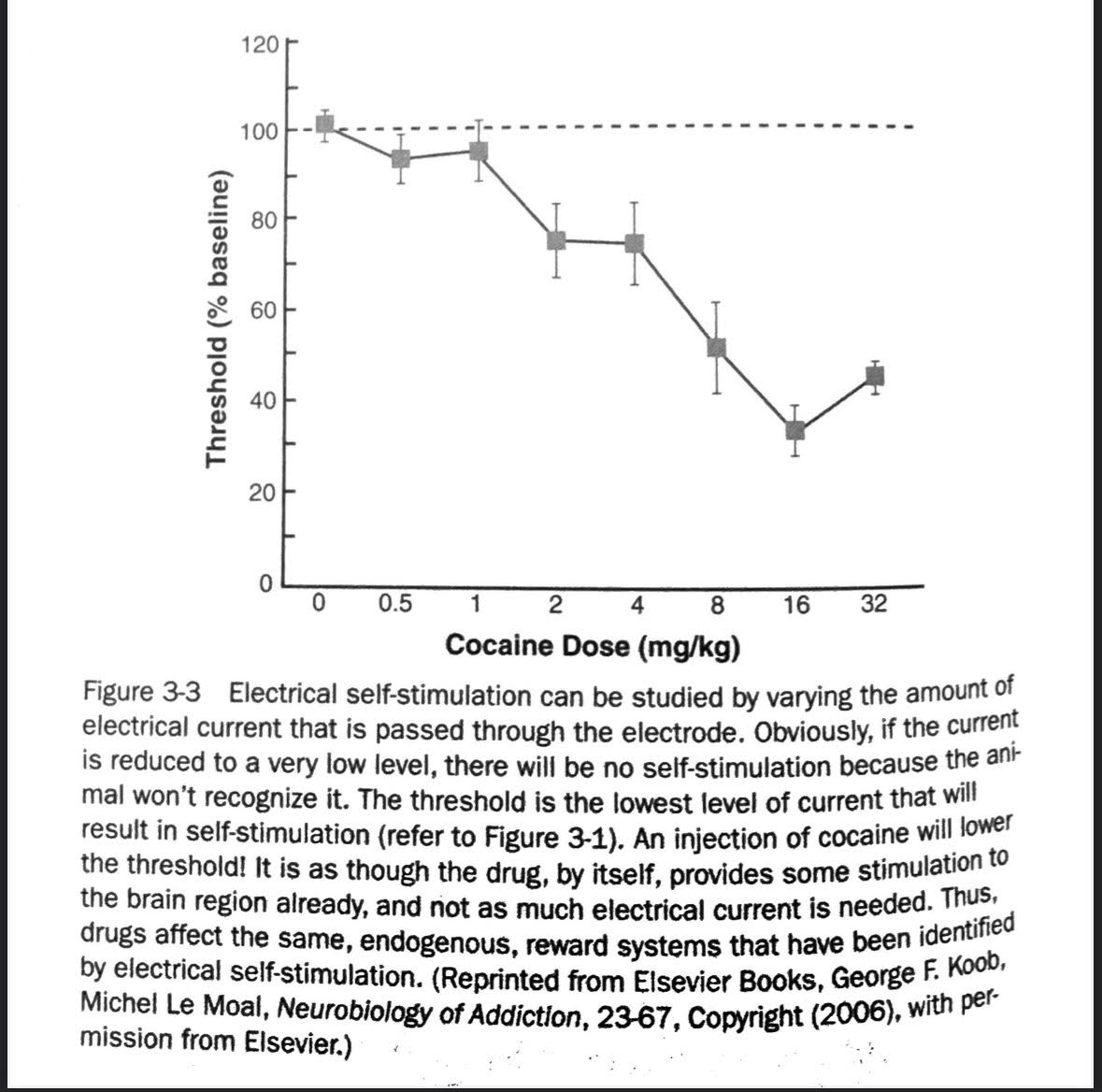
Mice were injected with dosages of cocaine, and as the amount of cocaine increased, the threshold required for electrical stimulation decreased.
By stimulating the reward centers directly, the necessity for substance-based stimulation subsided. What substances like cocaine sought to do was widen neural networks connected to the pleasure centers. By stimulating these centers, it eliminates the need for substances.
There is more to discuss, so I’m breaking this topic into three parts. I’m about to take off now, so I’m signing off.
Godspeed, gents, remember, “IT’S UP TO YOU!”
 check the press
Leave a comment